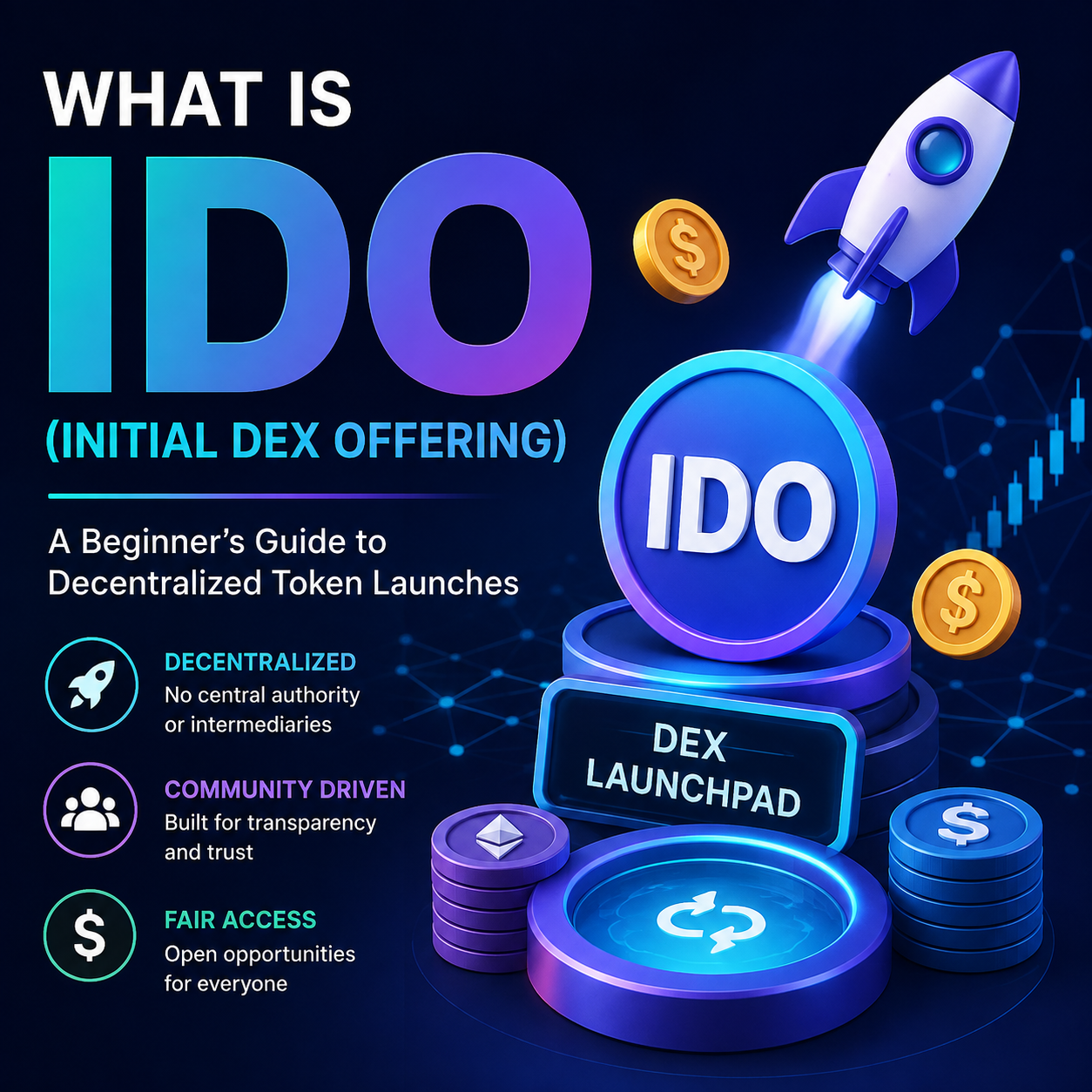
What Is an IDO (Initial DEX Offering)?
An Initial DEX Offering, or IDO, is a fundraising method in which a crypto project sells its new token directly to the public through a decentralized exchange or a dedicated launchpad, rather than through a centralized exchange or a private sale to institutional investors. The token is typically listed and made tradable within minutes of the sale closing, since liquidity is added to a decentralized exchange (DEX) as part of the launch itself.
IDOs emerged as a faster, more permissionless alternative to the ICO (Initial Coin Offering) boom of 2017–2018 and the IEO (Initial Exchange Offering) model that followed. Where an ICO required a project to run its own sale infrastructure and an IEO required a centralized exchange’s approval and listing, an IDO uses smart contracts and a launchpad platform to automate allocation, payment, vesting, and liquidity provisioning — cutting out most of the manual overhead and gatekeeping.
How an IDO Works
A typical IDO follows a fairly standard sequence:
- Launchpad selection: A project applies to or partners with an IDO launchpad, which vets the team, tokenomics, and smart contracts before agreeing to host the sale.
- Whitelisting or tier access: Many launchpads gate participation behind a whitelist, a KYC check, or a staking-tier system — the more of the launchpad’s native token you stake, the higher your guaranteed allocation.
- Sale structure: The token sale itself usually runs as either a fixed-price sale with a hard cap, a lottery-based allocation, or an auction-style format where price discovery happens on-chain.
- Liquidity provisioning: A portion of the raised funds is paired with newly minted tokens and deposited into a DEX liquidity pool (often locked for a fixed period), so trading can begin immediately after the sale.
- Token Generation Event (TGE) and vesting: Tokens are distributed to buyers, sometimes fully unlocked at TGE and sometimes released on a vesting schedule to discourage immediate dumping.
| ICO | IEO | IDO | |
|---|---|---|---|
| Where it happens | Project’s own website/contract | Centralized exchange | DEX or launchpad |
| Gatekeeper | None (high fraud risk) | Exchange vetting | Launchpad vetting |
| Listing speed | Delayed, manual | Fast, exchange-controlled | Near-instant, automated |
| Capital efficiency | Low (idle raised funds) | Medium | High (funds become liquidity) |
How to Succeed with an IDO as an Investor
– Research the team, audit reports, and tokenomics before committing capital — a token with no vesting schedule or an oversized team allocation is a red flag.
– Understand the launchpad’s tier system in advance and stake early if allocation size matters to you; tiers often lock in days or weeks before the sale.
– Have a plan for the token before you buy it — know whether you intend to hold through vesting unlocks or exit shortly after listing, since liquidity is often thin in the first hours.
– Size positions modestly and treat early trading activity as information, not confirmation — the first hours after listing often reveal whether real demand exists or whether the price is being propped up by short-term flippers.
How to succeed if you’re launching a project through an IDO:
– Pick a launchpad whose existing community and chain focus actually matches your target users, rather than the one with the biggest raise numbers.
– Design tokenomics with a real vesting schedule for team and private-round allocations — public perception of fairness affects both the sale and the token’s price stability afterward.
– Lock liquidity for a meaningful period (using a service like a token/liquidity locker) and publicize the lock; this single step does more for investor trust than most marketing spend.
– Line up market makers or a liquidity plan for the weeks after listing — a successful sale followed by a liquidity vacuum is one of the most common ways an IDO’s price collapses.
– Communicate constantly before and after the TGE; silence after a raise is one of the fastest ways to destroy community trust, even if the project is still building.
Investor Side Common Mistakes:
– Chasing allocation size instead of project quality — buying into every listed IDO regardless of fundamentals.
– Ignoring the vesting schedule and being surprised by sell pressure at each unlock.
– FOMO-buying immediately at listing, when volatility and thin liquidity are at their worst.
– Skipping the audit report, or trusting an audit that only covers part of the contract suite.
Project-Side Common Mistakes
- Over-allocating tokens to the team and private investors relative to the public sale, which signals misaligned incentives.
- Under-provisioning liquidity or failing to lock it, leaving the token vulnerable to a rug pull narrative even when unintentional.
- Launching on a launchpad or chain with no organic connection to the project’s actual user base, resulting in mercenary capital that exits at first opportunity.
- Treating the IDO as the finish line rather than the starting point — many teams under-invest in the post-TGE roadmap and community management.
- Rushing the smart contract audit or skipping a second audit after last-minute code changes.
Top IDO Platforms
The launchpad landscape has consolidated significantly since the crowded 2021 cycle, when well over fifty platforms competed for project deal flow. By 2026, only a small number of launchpads still maintain active pipelines with audited infrastructure and verifiable track records. Platforms that remain differ mainly in vetting rigor, chain coverage, allocation mechanics, and post-launch support. Some of the most established names include:
-
Polkastarte
– a multi-chain launchpad recognized for community-driven listings and early access to Web3 projects across several ecosystems.
-
DAO Maker
– a retail-focused platform built around risk-adjusted offerings and low entry barriers for everyday investors, paired with a Social Mining framework and an incubation program that provides advisory support beyond the token sale itself.
-
TrustSwap
– one of the longest-running launchpads in the space, with a track record spanning close to a hundred project launches over five years, operating alongside its own token-lock and vesting infrastructure.
-
Seedify
– a launchpad combined with an incubation program, particularly known within the GameFi sector for mentoring projects from early development through launch.
-
PancakeSwap
– a major BNB Chain-based IDO venue that has hosted dozens of partnered projects raising tens of millions of dollars combined, with its native CAKE token doubling as a governance and rewards asset.
-
Binance Launchpad
– technically an IEO venue rather than a pure IDO platform, but frequently grouped alongside IDO launchpads; it has reported a very high share of listed projects delivering positive returns, reflecting Binance’s strict vetting process.
-
BSCS (BSC Station)
– a multichain launchpad combining tier-based staking access with integrated DeFi tools within a broader ecosystem.
When evaluating any launchpad — whether as an investor choosing where to allocate or a founder choosing where to launch — it’s worth checking each platform’s audited-launch history, the chains it actually supports, its allocation and vesting mechanics, and whether it offers meaningful post-launch support rather than disappearing after the TGE.
Final Thoughts
IDOs solved a real problem — instant liquidity and permissionless access — but they didn’t eliminate the underlying risks of early-stage token investing. The mechanics have matured considerably since 2020–2021: tiered staking, on-chain vetting, and liquidity locks are now standard rather than exceptional. Still, the format rewards the same fundamentals it always has — solid tokenomics, real liquidity planning, and a team that treats the sale as day one rather than the exit.
Read Also-

Related Posts
OKTO Whitepaper V1
What is Delegated Proof of Stack?